
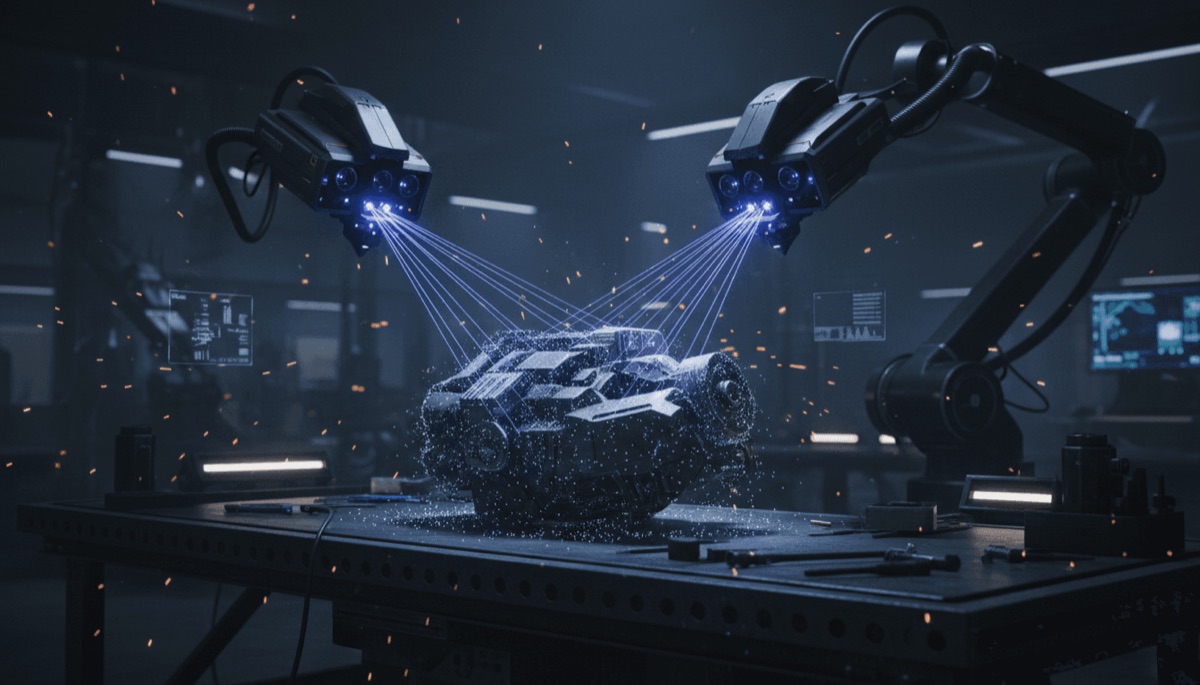
This capability is in development and will be available soon. CAD TECH is investing in adding professional 3D scanning to its service offering - a capability that most drafting services simply can't provide.
When it launches, 3D scanning will bridge the gap between physical reality and digital design. Whether you're reverse engineering a legacy part, fitting a custom component into an existing vehicle, or documenting as-built plant - the scanner captures it precisely so the CAD work starts from the real world, not a tape measure.
3D scanning removes the biggest constraint in custom design and reverse engineering work - working from inaccurate hand measurements. These are the types of jobs this capability makes possible:
Got a part with no drawings? Scan it, extract the geometry, and produce a fully dimensioned CAD model and manufacturing drawings - ready to replicate or modify.
Scan existing bodywork, chassis, or bays to get accurate geometry before designing custom brackets, panels, or fabricated components that fit first time.
Complex curves and compound surfaces are no problem. Scan hulls, interiors, or structural components to work from real-world geometry, not guesswork.
Plant, equipment, or structural installations that were never properly documented - scan and capture as-built geometry and turn it into a usable CAD model.
Scan the mounting environment before designing a custom fabricated component, eliminating the back-and-forth that comes from working off rough measurements.
Yes. CAD TECH works with clients Australia-wide. Most drafting work is handled remotely, with files sent back and forth digitally, so where you're based isn't a barrier.
All modelling and drafting is done in SolidWorks. Finished work can be supplied in the format your workshop or engineer needs, from native SolidWorks files through to STEP, DXF and PDF drawing packs.
Yes. Plenty of good parts start life as a sketch on a job sheet, a photo of a worn-out component, or a description over the phone. CAD TECH builds the 3D model from your sketch or idea, sends it through for approval, then produces the full manufacturing drawings.
Ten years on the tools as a boilermaker before drafting. The drawings are laid out the way a fabricator actually works: tolerances that suit the process, weld prep that can be done with the gear in a normal shop, and bend lines that account for what steel really does in a press.